
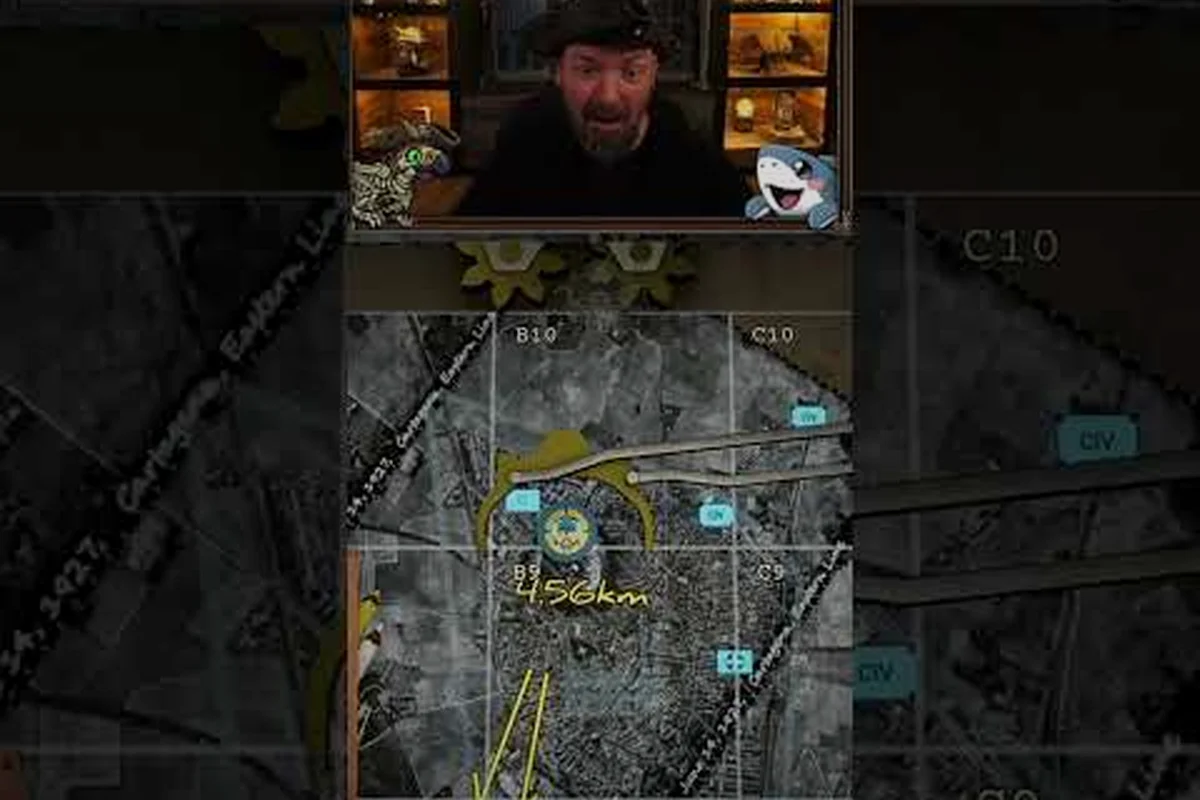
Few shooters force you to read a telegraph, plot a target on a tactical chart, and then crank a 5000-ton turret by hand before pulling a lanyard. Iron Nest does exactly that, and the reason it feels so grounded is that every bolt, breech, and bombardment sits on top of a meticulously imagined alternate history Spain. The Iron Nest setting borrows the bones of the real 1920s Iberian Peninsula — its geography, its social fault lines, its brewing civil conflict — then detonates the timeline so that diesel-powered armor marches where cavalry once charged.
Players stepping into the gunner's seat for the first time often notice the brass gauges before they notice the politics. Beneath the analog dials and crackling radio chatter, though, the Iron Nest setting on the official Steam page is a deliberate revision of Spanish history. By the time you finish your first firing solution, you will already have absorbed the outlines of a world where monarchy never fell, republic never declared, and an industrial war grinds forward across fifteen battlefronts. This guide unpacks the lore that makes every mission meaningful — from the divergence point that broke real history, to the factions that issue the orders you can choose to obey or defy.
The Divergence Point That Forged the Iron Nest Setting
Every alternate history rests on a hinge — a single moment when the real timeline cracks. For the Iron Nest setting, that hinge lands in 1923, when the real-life Primo de Rivera coup installed a military directorate in Madrid. The lore writers at developer Nick Nieuwoudt and designer Dominik Latos let that junta succeed beyond its historical shelf life, which means the Bourbon monarchy under Alfonso XIII never falls and the Second Republic is never proclaimed in 1931.
Because the republican uprising never materializes, the Spanish Civil War of 1936–1939 never begins in the form history records. Instead, the political energy that would have exploded into open conflict slowly fossilizes into a cold, grinding standoff between three entrenched blocs. By the time the game opens in the late 1930s, Spain has spent more than a decade under continuous mobilization, and the front lines have hardened into the fifteen war zones players rotate through.
What Stayed the Same in the Lore
The geography is faithful to real Iberia, which is why missions feel plausible even when the politics are fantastical. River crossings, mountain passes, coastal batteries, and rail hubs all map onto actual Spanish terrain that the developers studied during pre-production.
-
The Pyrenees still form a frozen northern barrier.
-
The Guadalquivir valley remains the agricultural heartland of the south.
-
Catalonia and the Basque Country keep their distinct industrial identities.
-
Madrid still sits at the political center, ringed by approaches that any gunner will recognize from a tactical map.
What Changed in the Timeline
The political departures from real history are sharper than the geographic ones. According to community lore summaries, the divergence cascades through several pivotal breaks that any player reading field manuals will recognize. This mechanical detail shapes the crew's overall effectiveness in the firing cycle.
| Real History (1923–1939) | Iron Nest Alternate Timeline |
|---|---|
| Primo de Rivera junta falls in 1930 | Military directorate consolidates power |
| Second Republic proclaimed 1931 | Monarchy persists under Alfonso XIII |
| Popular Front elected 1936 | Industrial blocs replace party politics |
| Civil War erupts July 1936 | Cold factional standoff drags on |
| Foreign volunteers (International Brigades) | Mercantile war-leagues hire out by theater |
| Conventional infantry combat | 5000-ton walking turrets dominate strategy |
The end result is a Spain that never experienced the catharsis of a civil war, and therefore never healed. That unresolved tension is exactly what powers the moral system that decides whether your orders are obeyed — or whether they appear in the in-game newspaper with your name attached. For a deeper look at how the 1920s context shapes individual missions, see the companion breakdown of the Iron Nest 1920s Spain setting.
The Three Factions Wrestling Over Iberia
Iron Nest lore does not frame the conflict as left versus right in the textbook sense. The writers replace partisan ideology with three industrial-political blocs whose names appear on telegraph chits and map overlays. Understanding who commands each theater is essential, because your orders always come signed by one of these factions — and the faction you serve shapes which newspaper headlines you wake up to.
The Royalist Directorate
Heir to the successful Primo de Rivera coup, the Royalist Directorate controls central Spain, the capital, and most of the Castilian plateau. Its forces are the best-equipped in the lore, which is why Directorate missions tend to introduce the heaviest artillery and the most forgiving resupply. Gunners who serve the Directorate typically report to a chain of command that values procedural discipline — telegraph etiquette, logbook entries, and clean firing data all matter more than raw speed.
The Mercantile Leagues
Loosely modeled on the industrial federations of Catalonia and the Basque Country, the Mercantile Leagues operate as contract-warriors. They hire out their factories, rail capacity, and turret crews to whichever Directorate commander pays best, which means their loyalties shift from mission to mission. Players serving the Leagues encounter the broadest mix of targets and the most morally ambiguous orders, because the Leagues are willing to shell civilian infrastructure if the contract price is right.
The Syndicalist Workers' Councils
Born from the same labor movements that birthed anarchism in real Barcelona, the Syndicalist Councils control the southern agricultural belt and parts of the Mediterranean coast. They field older, jury-rigged turrets and depend on partisan intelligence to compensate for technological inferiority. Their missions push the player toward long-range indirect fire, urban counter-battery duels, and the kind of asymmetric engagements where your tactical map becomes as important as your ballistic calculator.
A more granular comparison of command structures and how each faction treats disobedience lives in the monarchy vs republic faction guide, which traces the same political split from a different angle. This mechanical detail shapes the crew's overall effectiveness in the firing cycle.
Diesel-Punk Technology and the Walking Turret
The most visually arresting element of the Iron Nest setting is also its most lore-significant: the 5000-ton quadrupedal walking turret. These machines are not fantasy mechs in the anime sense. They are extrapolations of real 1920s engineering — riveted steel plating, exposed valve gear, steam-and-diesel hybrid powerplants — scaled up to siege scale.
According to the lore notes circulated by the developer team, the turrets emerged from a single "what if" question: what if interwar industrialists had poured their steel budgets into walking artillery instead of trench warfare? The answer produced a vehicle class that dominates every battlefield, because a turret that can reposition under its own power eliminates the need for rail logistics and out-ranges anything a 1920s field army can field.
The Six-Step Firing Loop as Lore
Players often treat the game's signature mechanic — the six-step firing loop — as pure gameplay, but it doubles as diegetic worldbuilding. Every step you perform inside the turret is also the step a real gunner of the period would take, only compressed into one crew.
| Firing Step | In-Game Tool | Real-World Equivalent |
|---|---|---|
| Receive intelligence | Telegraph receiver | Field telephone + written orders |
| Plot the target | Tactical map with stylus | Map board + grease pencil |
| Solve the firing data | Ballistic calculator | Range tables + slide rule |
| Load the projectile | Manual shell hoist | Powder crew + rammer |
| Load the propellant | Charge cage + ram rod | Bagged powder + primer |
| Aim and fire | Elevation/azimuth handwheels | Traversing gear + lanyard |
Each tool in the loop is therefore not just a gameplay mechanic but a piece of 1930s artillery procedure that the developers chose to simulate faithfully. That fidelity is part of why Iron Nest lore feels grounded rather than steampunk whimsy.
Why Walking Turrets Make Historical Sense in the Setting
The developers grounded the walking turret concept in three real engineering currents that existed before the divergence: the Spanish military's ongoing mechanization program under Primo de Rivera, the early tractor-tread experiments at the Trubia armory in Asturias, and the metallurgical breakthroughs in case-hardened steel that made heavy mobile platforms feasible on the rugged Iberian terrain.
-
Petrolemobile experiments of the 1910s–1920s proved that large internal-combustion plants could propel heavy platforms.
-
Steam traction engine heritage gave designers a vocabulary for articulated legs and reciprocating drives.
-
Railway artillery of the late 1800s established the doctrine of massive, slow-moving siege guns.
Combine those currents with a Spanish industrial base that never had to rebuild after a civil war, and the quadrupedal turret stops feeling like science fiction and starts feeling like an inevitable escalation. That grounding is also why players who read the field manuals describe the world as "plausible diesel-punk" rather than "fantasy mecha."
The Fifteen War Zones and Their Lore Context
The fifteen theaters you rotate through are not just maps; they are fifteen vignettes of a Spain stuck in an unresolved civil war. Each war zone encodes a specific political and historical subtext, and recognizing that subtext is what turns a routine fire mission into a story beat.
| War Zone | Region | Faction Control | Lore Context |
|---|---|---|---|
| Sierra Pass | Pyrenees foothills | Royalist Directorate | Border fortification against foreign observers |
| Guadarrama Corridor | Central mountains | Contested | Approach to Madrid from the north |
| Meseta Plains | Castilian plateau | Royalist Directorate | Industrial breadbasket and rail hub |
| Ebro Crossing | Catalonia border | Mercantile Leagues | Major river bridge, constantly shelled |
| Bilbao Foundry | Basque Country | Mercantile Leagues | Heavy industry and turret manufacturing |
| Tarragona Harbor | Mediterranean coast | Syndicalist Councils | Smuggling lifeline for southern supplies |
| Guadalquivir Marshes | Andalusia | Syndicalist Councils | Agricultural heartland, partisan territory |
| Cartagena Dockyard | Southeast coast | Contested | Naval-supply port, naval guns |
| Cordoba Rail Hub | Andalusia | Contested | Junction where three faction lines meet |
| Zaragoza Plateau | Aragon | Mercantile Leagues | Dry plateau favoring long-range fire |
| Asturias Mines | North coast | Syndicalist Councils | Coal mines fueling turret powerplants |
| Galicia Highlands | Northwest | Royalist Directorate | Remote, defended by mountain forts |
| Valencia Citrus Belt | East coast | Syndicalist Councils | Food-supply region, low-intensity raids |
| Madrid Perimeter | Central | Royalist Directorate | The capital, ringed by Directorate forts |
| Strait of Gibraltar | Southern tip | Contested | Strategic chokepoint with foreign shipping |
Reading the lore of each war zone gives you a sense of how long the unresolved conflict has dragged on — the longer-named theaters such as Ebro Crossing and Guadalquivir Marshes carry the verbal shorthand of war correspondents who have been filing the same dispatches for years.
Morality, Newspapers, and the Lore of Disobedience
One of the Iron Nest setting's most distinctive lore beats is the newspaper consequence system. Every time you decline an order — refuse to fire on a civilian target, hold fire to let civilians evacuate, or deliberately miss to waste ammunition — the next in-game morning publishes the outcome on the front page of a paper that exists within the world.
The system is more than flavor text. According to player testing reported on the Steam Community discussions, the paper tracks how your actions have been spun by the propaganda apparatus of whichever faction you serve. A Directorate gunner who defies orders might find themselves lionized as a hero in the Syndicalist press but tried in absentia by a Directorate court-martial. The lore here draws directly on the press traditions of 1930s Spain, when newspapers were openly partisan and editorial choices could move public opinion as much as battlefield outcomes.
The full mechanics of this obedience-versus-defiance choice are unpacked in the obey or defy orders explainer, which maps out how different factions frame your actions. For the broader pre-launch version history that added this system, the early access updates log records when each newspaper beat shipped.
Sources of Iron Nest Lore Outside the Game
Because the game is set to launch on August 6, 2026, much of the deep lore lives outside the executable itself. Players building a complete picture of the alternate history Spain setting pull from several community-maintained sources. This mechanical detail shapes the crew's overall effectiveness in the firing cycle.
The Community Wiki
The iron-nest.wiki maintains a systems compendium and a review hub. Players should treat any wiki page dated before the August 2026 launch as pre-release documentation, which may have shifted between the demo and the full release. The "Everything We Know" review page is the most cited single source for the divergence timeline and the faction breakdown.
Steam Community Threads
The Steam Community hub hosts ongoing discussions where the developers clarify lore points. Several pinned threads collect community questions about the Royalist Directorate's chain of command and the Syndicalist Councils' partisan intelligence network, and the dev team has used those threads to confirm which lore elements are canon versus flavor.
Creator Deep Dives
Since the demo peaked at roughly 1,238 concurrent players during Steam Next Fest in June 2026, several content creators have produced long-form lore breakdowns. As of August 2026, the most-watched community explainer sits above 70,000 views and traces the divergence year by year, which makes it a useful companion to written lore summaries. Players hunting for the video should search for the title on YouTube directly, because community uploads are still being re-cut in the weeks leading up to launch.
How Lore Shapes Your Tactical Decisions
The lore is not window dressing. It informs how you should read every order you receive, because the faction that issues a fire mission has a reason to issue it. Recognizing that reason is the difference between completing a mission as intended and creating a newspaper headline that follows you into the next deployment.
Reading Telegraph Orders Like a Lore Document
Every order you receive by telegraph carries the signature of the issuing faction. Directorate orders tend to be procedural, with explicit range and timing data. Mercantile League orders read like contracts, with payment terms and target quotas. Syndicalist Council orders are terse and code-heavy, often omitting context because partisan couriers are assumed to know the local situation. Reading those signatures is itself a lore skill, because it tells you which faction is invested in the outcome and which is just collecting a fee.
Plotting Targets on the Tactical Map
The tactical map doubles as a lore surface. War zones where the Directorate controls the rail hubs tend to feature more gridded survey data, while Syndicalist-held territory offers cruder sketch maps full of partisan shorthand. Players who learn to read the map's provenance can predict where the ambush points will appear, because partisan maps emphasize what partisans need to know — escape routes, civilian shelters, counter-battery hiding spots.
For newcomers still learning the six-step loop and how it feeds into the ballistic calculator, the first firing solution walkthrough maps each lore element back to the corresponding gameplay action. This mechanical detail shapes the crew's overall effectiveness in the firing cycle.
The Historical Threads That Echo Inside the Game
For players who want to dig deeper into what the writers borrowed from real Spain, several historical threads run directly into the Iron Nest setting. The game does not invent its industrial backdrop from scratch; it remixes real Spanish history in ways that reward outside reading.
-
The 1920s industrial boom in Catalonia and the Basque Country, which historically produced a heavy-industry workforce that later fueled republican militias.
-
The Rif War of 1921–1926 in Morocco, which trained the Spanish Army in colonial counterinsurgency and left many officers available for the alternate junta's use.
-
The university protests of 1927–1929, which in real history fed republican sentiment but in the Iron Nest timeline are co-opted by Syndicalist organizers.
-
The naval modernization plans of the early 1930s, which here push the Syndicalist Councils to invest in coastal turret batteries instead of battleships.
Recognizing these echoes is what lets a lore-focused player feel that the alternate history Spain setting is not arbitrary. Every mission sits on a foundation of real Spanish history that has been carefully tilted off its axis. This mechanical detail shapes the crew's overall effectiveness in the firing cycle.
Frequently Asked Questions
What year does the Iron Nest alternate history Spain setting begin?
The divergence starts in 1923, when the Primo de Rivera coup is allowed to consolidate power. By the time players take their seats inside the turret, the timeline has run for roughly fifteen to sixteen years into a cold factional standoff that never resolves.
Who controls the Spanish capital in the Iron Nest setting?
The Royalist Directorate holds Madrid throughout the game. The capital is ringed by Directorate forts that you will encounter repeatedly across the campaign, which is why Directorate missions tend to favor heavy, long-range engagements. Narrative awareness enhances the campaign experience and unlocks alternative story paths.
How many war zones does the Iron Nest setting include?
The launch campaign ships fifteen war zones, each tied to a specific region of the Iberian Peninsula. They range from the Pyrenees foothills in the north to the Strait of Gibraltar in the south. Narrative awareness enhances the campaign experience and unlocks alternative story paths.
Does the alternate history change real Spanish geography?
No. Geography stays faithful to the real Iberian Peninsula, which is why the Pyrenees, the Ebro, the Guadalquivir, and the Mediterranean coast all feel recognizable. Only politics, industry, and military doctrine diverge. Narrative awareness enhances the campaign experience and unlocks alternative story paths.
Where can I read the most complete Iron Nest lore summary?
The community-maintained iron-nest.wiki review hub collects the broadest pre-launch lore summary, while the Steam store page hosts developer-curated lore excerpts. Players should note that wiki pages dated before the August 6, 2026 launch may shift once the full release ships.