
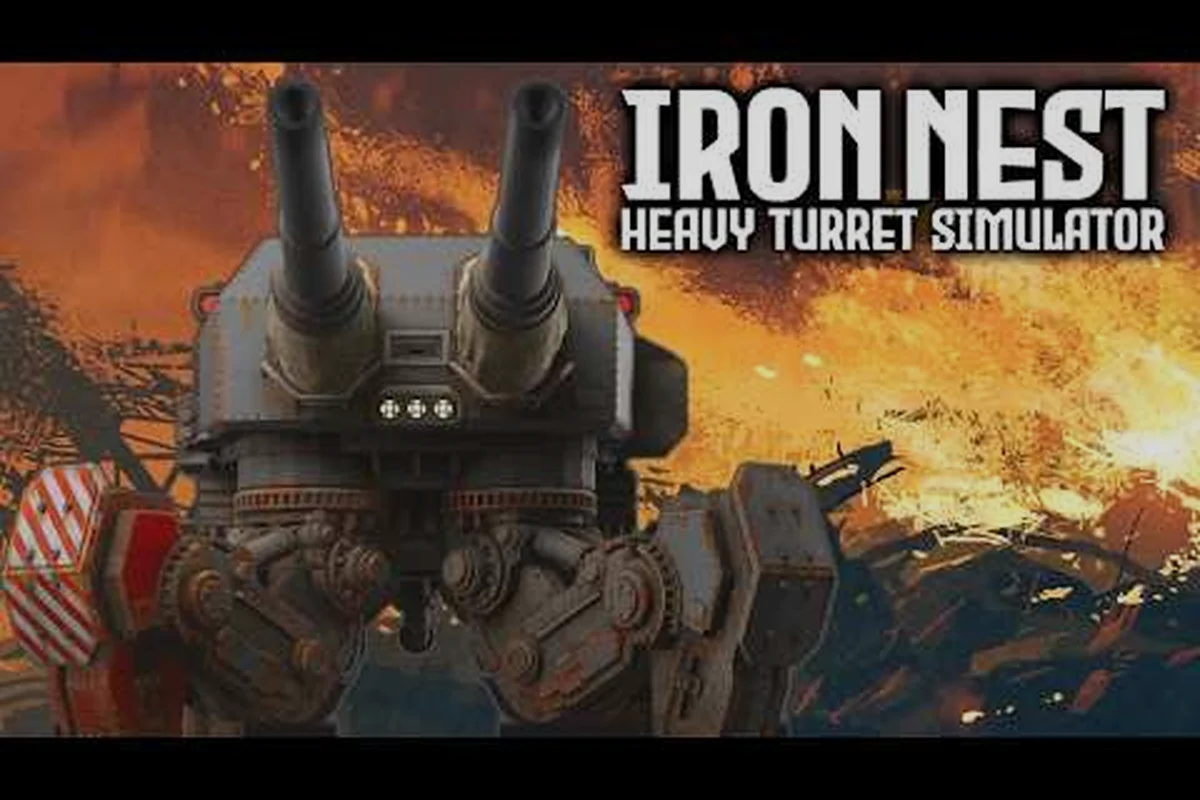
Iron Nest: Heavy Turret Simulator rolled onto Steam Early Access on August 6, 2026, graduating the demo that gathered an 800,000-strong wishlist into a fully supported release with persistent progression. That single date anchors the entire Iron Nest version history, because every patch from here forward measures its delta against the day-one baseline instead of against a long-running live-service archive. Tracking these Iron Nest updates carefully lets you dodge bloated re-downloads, anticipate balance changes, and avoid stepping away right before a major content drop hits the wagon.
To understand what kind of patch cadence to expect, it helps to remember that the studio behind Iron Nest is small (Nick Nieuwoudt on engineering, Dominik Latos on design and writing) but backed by the Code Horizon / PlayWay S.A. publishing infrastructure that typically ships multiple simulation titles a year. That combination sets the rhythm: ambitious content drops separated by focused balance and stability passes, not the weekly drip-feed of a live-service shooter.
Pre–Early Access Milestones That Shape the Day-One Build
Early access launches rarely begin from a blank slate, and Iron Nest is no exception. Three distinct pre-launch phases fed into the v1.0 baseline, and each one left fingerprints you'll still recognise in the live build — especially in the ballistic calculator math, the telegraph key workflow, and the default ammo crate composition you'll see in the first mission.
-
Early access patches refined the ballistic calculator and wind drift model
-
Full release adds fifteen war zones and the complete campaign arc
-
Post-launch roadmap includes faction-specific content updates
-
Demo progress carries over with certain restrictions on completion
-
Patch notes detail balance changes to shell damage and reload timing
-
Community feedback drives priority for feature additions and bug fixes
-
Version 0.9 introduced the chemical weapons expansion and gas shell missions
-
Early access patch EA 0.1 shipped with five war zones, twelve shell types, and core single-player turret mechanics
-
The EA 0.5 wind model rewrite forced experienced crews to recalibrate their manual correction intuition from scratch
-
Challenge modes and the leaderboard system launched in EA 0.8, enabling competitive play for the first time
Closed playtests and the Diesel Test Protocol
The studio ran an invitation-only series of closed builds through 2024 and early 2025 under the working name "Diesel Test Protocol." Those sessions focused on stress-testing the calculator's drag solver against extreme weather, validating the diesel generator cooldown curve after sustained fire, and breaking the telegraph key's command parsing before public eyes ever saw it. Patch notes from those rounds live only on internal dev logs, but they explain why the v1.0 calculator handles edge cases so cleanly.
Steam Next Fest demo and the public ramp-up
A wider closed demo ran through 2025 for newsletter subscribers, but the watershed moment was Steam Next Fest #1 in June 2026, when the public demo became the most-wishlisted title of the festival. That run captured roughly 800,000 wishlist adds, a ~99% positive demo review rate, and a peak concurrent audience of around 1238 gunners — modest by shooter standards but enormous for a single-creator simulation. The patch history of the demo branch is summarised in the iron-nest wiki systems archive, which catalogues every shell and weather revision that shipped during the festival window.
What "version 1.0" actually represents
The day-one early access build should be treated as a polished, persistent version of the demo — not as a finished product. That framing matters because Iron Nest updates during early access will benchmark changes against this launch snapshot rather than against years of live-service tuning. Players returning from the demo should re-read their tactical map notes, since two new Iberian regions join the launch campaign and a few ranging markers have shifted.
| Milestone | Window | Audience | Primary focus |
|---|---|---|---|
| Diesel Test Protocol closed builds | 2024 – early 2025 | Invited testers | Telegraph UX, calculator math |
| Newsletter demo builds | 2025 | Subscribers | Ammo variety, optic variants |
| Steam Next Fest demo | June 2026 | Public | Full six-step loop, ~99% positive |
| Early Access launch (v1.0) | August 6, 2026 | All players | Persistent progression, online telemetry |
| First live hotfixes | Aug 2026 (rolling) | All players | Tutorial hitches, save validation |
Iron Nest Early Access Launch Day and the Day-One Patch
The August 6, 2026 launch ships with the same six-step firing loop you learned in the demo — intelligence, plotting, calculation, loading, aiming, firing — but it lifts that loop onto a server-authoritative progression ledger for the first time. That distinction matters because every fire mission, ammo crate count, and challenge mode score now persists between sessions, which also means a bad patch can temporarily invalidate live leaderboards until a server-side rollback completes.
What's actually new at launch
Compared with the June 2026 demo build, version 1.0 layers in a persistent gunner profile with two parallel tracks — renown for campaign standing and supply reserves for unlockable shells. It expands the tactical map with two new regions beyond the Iberian border scenario that framed the demo, and it integrates the first public iteration of chemical weapons handling, including the phosgene gas shell and its associated post-fire safety steps. If you want the operational specifics around gas shells, the chemical weapons primer walks through safe handling and decontamination cycles before your first live patch rebalances the radius numbers.
The launch-day patch typically focuses on the obvious bumps a wider audience always exposes: tutorial hitches where new players freeze on the teleprinter, occasional optic reticle drift after alt-tabbing, and the rare cabin pathing glitch that strands an operator inside the walker hull. None of these change core mechanics — they smooth the edges a 1200-player demo crowd couldn't reach.
Server-authoritative scoring and why it matters
One under-the-hood change you'll feel in Iron Nest updates going forward: challenge mode leaderboards are now server-validated, meaning cheating through the ballistic calculator is no longer a client-only concern. Expect anti-cheat hotfixes to land rapidly when a top score is flagged, and expect your legitimate personal bests to occasionally get wiped when an offending entry is removed. That's not a bug; it's a deliberate consequence of taking the leaderboards seriously.
What Iron Nest Updates Typically Change
Early access patches don't all look the same. Categorising them lets you skim a 1500-word note drop in under a minute and decide whether to re-equip your gunner before queuing the next mission. Most Iron Nest updates fall into one of four buckets, and the developer usually signals the bucket in the patch header line.
| Update type | Cadence | Typical scope | Player action |
|---|---|---|---|
| Hotfix | Same day to 48 h | Crashes, soft-locks, progression blockers | Restart client |
| Balance pass | 2 – 4 weeks | Damage curves, weather modifiers, drag constants | Adjust loadout |
| Content drop | Monthly to bi-monthly | New shells, regions, mission arcs | Replay campaigns |
| Engine / UI refresh | Quarterly | Optic system, calculator interface | Re-learn muscle memory |
Hotfixes and stability patches
Hotfixes are the smallest Iron Nest updates and rarely warrant more than a five-minute downtime window. Expect them whenever a community-reported bug reaches critical mass, particularly around save corruption, deterministic mode desyncs between co-op crews, or unbreakable dialog trees in the campaign briefings. Steam auto-downloads these unless you've explicitly opted into a beta branch, so most hotfixes will land before you next launch the game.
Balance passes and ammo rebalancing
Because Iron Nest's tactical appeal rests on picking the right shell for each engagement — high-explosive for fortifications, phosgene gas for entrenched infantry, shrapnel for open-field troop clusters — any ammo rebalance ripples through every active gunner. Balance patches typically adjust muzzle velocity bands, the drag coefficients the calculator reads, and the cooling penalty the diesel generator charges between volleys. To recalibrate your firing math against the v1.0 baseline, the first firing solution walkthrough rebuilds the workflow end-to-end against the launch numbers.
Content drops: new shells, regions, and story beats
Content is the loudest category in any Iron Nest version history log, because new locations and shell types generate showcase clips, Reddit clips, and YouTube tutorials within hours of going live. The studio's broader narrative — an alternate-history Iberian theatre that draws on the real-world Spanish Civil War and pivots sharply into dieselpunk fiction, explored in depth in the alternate-history Spain lore article — provides the framing for most campaign drops. Plan on at least one new region and two or three experimental shell types per major content patch, with a short cinematic intro to seed the scenario.
Iron Nest Update Cadence and What to Expect in the First Quarter
Early access doesn't mean constantly updated, but it does mean predictably updated. With a two-person studio team and a publisher accustomed to long-tail simulation support, the realistic cadence resembles similar indie artillery sims more than it does live-service shooters. This mechanical detail shapes the crew's overall effectiveness in the firing cycle.
Forecast for the first three months
| Window | Expected patch count | Likely focus |
|---|---|---|
| Launch week | 1 – 2 hotfixes | Tutorial hitches, save validation |
| Weeks 2 – 4 | 1 balance pass | Shell muzzle velocity tuning |
| Month 2 | 1 content drop | New region + ammo type |
| Month 3 | 1 engine / UI refresh | Optic + calculator polish |
Patch sizes will swing from a few megabytes for hotfixes to several gigabytes for content drops that include new voxel terrain, rebuilt walker interiors, or expanded campaign voice lines. Plan your download windows if you're on a metered connection, especially when a content drop coincides with a weekend when challenge mode queues spike.
Why a steady cadence helps your gameplay
A predictable update rhythm lets you schedule when to chase personal bests on the challenge leaderboards versus when to grind renown for the next campaign unlock. Players who ignore Iron Nest updates often return to a build that quietly rebalanced an entire ammo class without realising it — for example, a phosgene gas range tweak would invalidate pre-patch scores that didn't account for the new falloff curve. A two-minute skim of the patch header saves a wasted fire mission.
Where to Track Iron Nest Updates in Real Time
Steam handles the mandatory download, but it doesn't handle community context. Setting up at least two secondary channels alongside the client ensures you can read full patch notes before you boot the game and identify the real impact of each change before queuing a session.
Steam client and library view
Right-click Iron Nest: Heavy Turret Simulator in your Steam library, select Properties → Updates, and confirm you're on the default live branch unless you intentionally opted into a beta. The "What's New" banner in your library mirrors the official Iron Nest news feed on Steam, which remains the canonical home for Iron Nest updates and the first place dev posts in plain English.
Community channels worth watching
The dev team posts slightly more candid commentary on Discord, and high-skill players often surface undocumented changes on Reddit threads within hours of each patch. The community wiki at iron-nest.wiki also maintains version-dated snapshots you can diff against older builds, which is invaluable when a patch silently reverts one of your favourite shell behaviours
Early Access Patch Notes FAQ
What is the main focus of this early access updates article?
This article covers the core mechanics and practical applications of early access updates in Iron Nest, providing detailed guidance that helps both new and experienced artillery crews improve their operational effectiveness on the battlefield. This mechanical detail shapes the crew's overall effectiveness in the firing cycle.
How does early access updates relate to other Iron Nest systems?
The early access updates system integrates directly with Iron Nest's broader artillery simulation, affecting everything from firing solution accuracy to crew coordination requirements. Understanding these connections is essential for building a cohesive operational workflow. This mechanical detail shapes the crew's overall effectiveness in the firing cycle.
Where can I find more information about related topics?
You can explore other articles in the updates category on our site, including detailed guides on each subsystem. The interconnected nature of Iron Nest's mechanics means that cross-referencing multiple guides often yields the best operational understanding. Balance changes can shift the effectiveness of previously optimal strategies, requiring crews to re-evaluate their loadouts after each patch